Lids
From time to time, we suddenly have more bees than boxes. This is typical of beekeepers. When this happens, Jim gets to work. This week, it has been lids and bases.
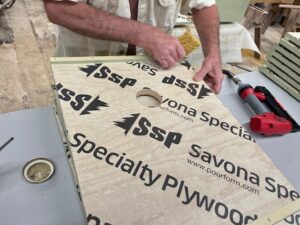
We have tried 4-sided wooden lids covered with metal roofing, which are great, but no good for top feeding, which we do. We transitioned to migratory lids, which are much simpler, just the lid and a strip at each end to keep the lid on the box, with a 71mm hole drilled to hold a regular-mouthed jar, usually a quart. We wanted to use high density overlay plywood, which has a plastic covering, but could not find a supplier. Instead, we made bunches of 4, 5 and 10 frame lids from Azec, the PVC building siding product. They work very well, but a 4’ x 8’ sheet is not cheap. Then, we finally found our source for HDO, the Blue Ridge Honey Co. in Lakemont, GA. We just happened to be nearby, and brought several sheets home.
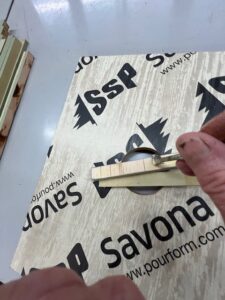
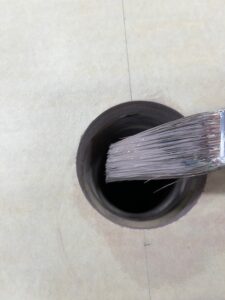
This product is the bee’s knees. A finished lid is solid, weather-proof, and a touch better insulated than PVC. For a 10-frame, cut a piece 16 ⅝ x 20 ½, from the cutoff make ⅜” strips and glue them in place before securing to the lid with a staple. Do the same for the other widths of boxes, allowing a scant ¼” on each side of the box for overlap. The raw edges, only, need to be finished, and for this we used 2 coats of exterior primer and 1 coat of exterior paint, both acrylic-based.
Bases
Our first equipment had screened bottom board bases. They were designed for mites to drop through, and when a sticky board was inserted under the screen, mite drops could be counted, Plus, you could look at the stuff on the sticky board and know what the bees were doing without opening the hive. Then we began using oxalic acid vaporization for mite treatments, and quickly found out that it was nearly impossible to plug the base in order to keep the vapor in the hive.
The current best bee box design is the ‘condensing hive’, which is modeled on tree cavities. The lid is insulated, the base is solid, and water vapor produced by the bees’ respiration condenses on the walls of the hive, supplying them something to drink. The air exhausted from the colony leaves at the lower entrance. No vapor escapes during OA