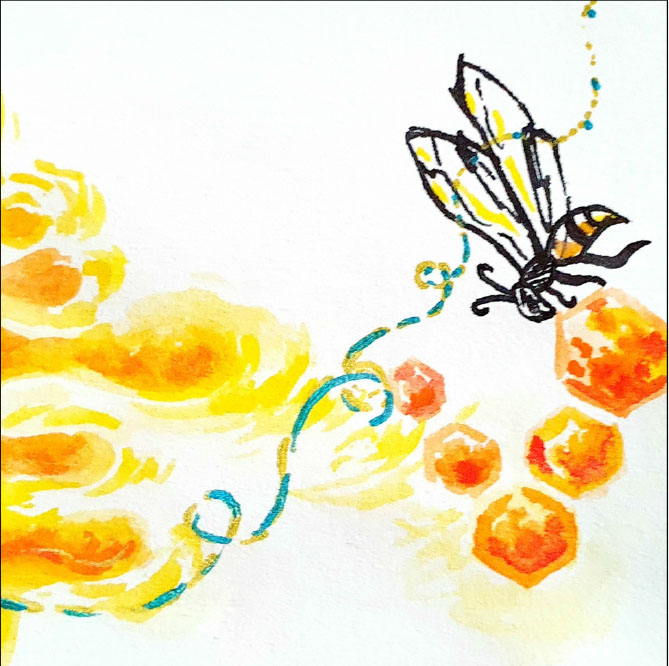
The end of October is a sad and eerie time of year, associated with many traditions reminding us that all life is transitory– Halloween, the Day of the Dead, Samhain, the Gaelic festival marking the transition from light to dark, when the veil between the physical world and Otherworld thins…
At the bee club meeting last night, a member’s family had asked for help getting his hives fit for winter, as he was doing very poorly. It led us to wonder, what would happen if we died and OUR hives were left without anyone to care for them? Surely they would miss us, but then what? They are just bugs, but they are also so much more than just bugs, possessing a spirit all their own, a spirit they share with us. Or so it seems, when we visit them.
On that cheery note, it seemed like a fitting time to look into the old custom of ‘telling the bees’. The following excerpt from https://daily.jstor.org/telling-the-bees/ Colleen English, 2018, takes a deep dive into the topic.
“This practice of “telling the bees” may have its origins in Celtic mythology where the presence of a bee after a death signified the soul leaving the body, but the tradition appears to have been most prominent in the eighteenth and nineteenth centuries in the U.S. and Western Europe. The ritual involves notifying honey bees of major events in the beekeeper’s life, such as a death or marriage.
While the traditions varied from country to country, “telling the bees” always involved notifying the insects of a death in the family—so that the bees could share in the mourning. This generally entailed draping each hive with black crepe or some other “shred of black.” It was required that the sad news be delivered to each hive individually, by knocking once and then verbally relaying the tale of sorrow.
Charles Fitzgerald Gambier Jenyns, a British Victorian apiarist and rector, in his A Book about Bees (1886) asserts that this message should be delivered to the hives at midnight. In other regions, like in Whittier’s New England, they simply hung crepe on the hive and then sang to the bees that, “So-and-so is dead.” Other variations include merely telling (rather than singing) or whispering the information. In some places they may say “Little brownies, little brownies, your master (or mistress) is dead.”
Tammy Horn, a literary scholar and apiarist, writes in Bees in America: How the Honey Bee Shaped a Nation (2005) that in New Hampshire, the news of a death must not only be sung, but the verses must also rhyme. She provides a sample verse: “Bees, bees, awake! / Your master is dead, / And another you must take.” If the bees begin to buzz after this information has been delivered, it is seen as a good omen.
Horn also writes of another death custom associated with bees: that of “ricking,” a ritual that required the eldest son in the bereaved family to shift all of the hives to the right in order to signify that a change has occurred. Another take on this was to shift the hives so that their entrances faced the family home. This tended only to occur if the deceased was being waked in the home.
The consequences of not telling the bees could be dire. Another Victorian biologist, Margaret Warner Morley, in her book The Honey-Makers (1899), cites a case in Norfolk where a man purchased a hive of bees at an auction. When the man returned home with them, the bees appeared very sickly. It occurred to their new owner that they hadn’t been properly put into mourning after the death of their former owner. He decided to drape the hive with black cloth, and soon after he did, the bees regained their health. There are also tales of entire bee colonies dying if the family failed to notify them of a death.
Throughout the nineteenth-century and well into the twentieth, there were reports of rural people who firmly believed in this tradition of telling the bees. There is even a report of bees brought to a funeral, presumably after being told of the death. In 1956, the AP reported a strange occurrence at the funeral of John Zepka, a beekeeper from the Berkshire Hills. As the funeral procession reached the grave, the mourners discovered swarms of bees hanging placidly from the ceiling of the tent “and clinging to floral sprays. They did not annoy the mourners—just remained immobile.” According to a New York Times dispatch from Adams, MA, published on July 16, 1956: “Nothing like it had ever been seen before.” This curious case seemed to confirm the need to “tell” the bees, further strengthening the conviction that there exists a mournful sympathy between bees and humans.”
Totally agree, there does exist a ‘mournful sympathy’ between us and our little friends!
It wasn’t always bad, though…
“Unhappy events were not the only occasions that the bees were invited to participate in. The bees were in fact so integral to human rituals that Cole notes of a wedding: “The little workers were to be informed of the event, and receive a bit of wedding cake.” The hives were sometimes adorned with flowers to celebrate the proceedings. Morley (the Victorian biologist) observes that, in Brittany, it was traditional to decorate the hives for wedding celebrations with scarlet cloth, while in Westphalia, Germany, the newlyweds must introduce themselves to the bees or else they will have an unlucky marriage. This homage paid to the bees during nuptials could be a way of compensating the creatures for the vast amounts of honey consumed during the celebrations.”
Either way, happy or sad, it’s time to enact an estate plan for the apiary.