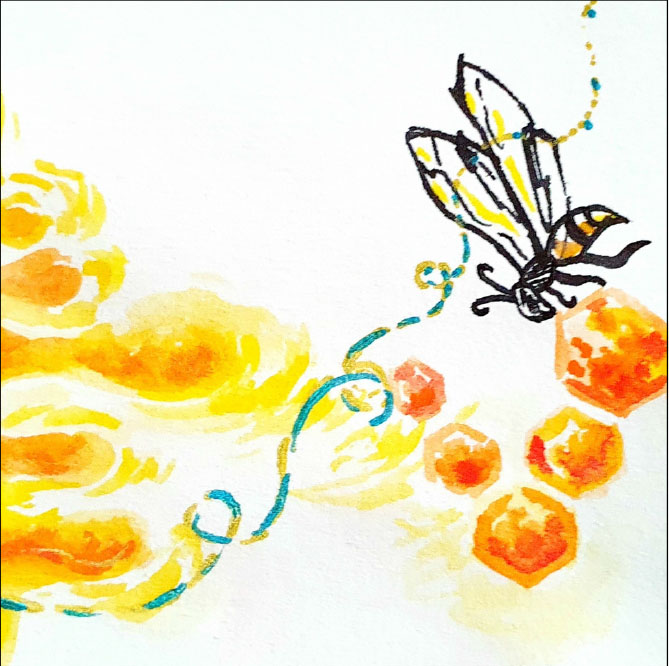
We are Jim and Jane Todd, 5275 Millbrook Road, southwest of Wooster.
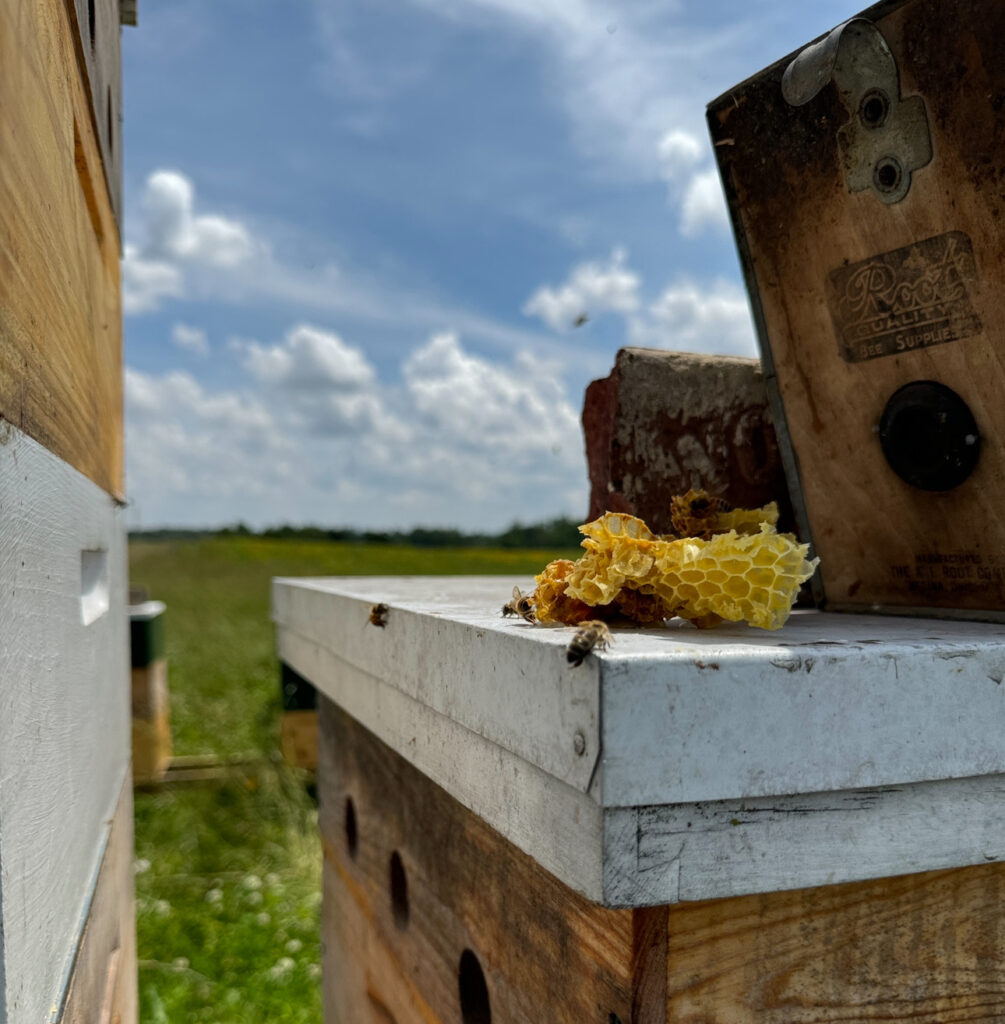
Our farm sits about one mile west of the Killbuck Marsh Wildlife Preserve, north of the village of Millbrook, home of the Kister Mill. We sell honey, beeswax, and a small number of spring and overwintered nucleus colonies. Our 100-ish hives sit on 40 acres. We were full-time farmers for 25 years, producing crops, market hogs, and beef cattle. We then took day jobs. Jim worked as the Wayne County Weights and Measures Inspector, and Jane worked as the entomologist in the USDA-ARS Corn and Soybean Research Unit. We retired in 2021 and have increased the size of the apiary each year. Jim makes the woodenware and Jane looks after the bees and records.
We began in 2016 with 2 hives and 2 packages of bees. Jim announced that he could build bee equipment as good if not better, so we then had 6 hives, and lost 4 that first year, to varroa mites we later learned. We replaced the losses with packages, and swore never to do packages again if we could figure another way. A friend told Jim how much fun he would have catching swarms, and then we had 20 colonies. Soon we had 30, learned how to rear queens, retired from our day jobs, and now have a lot more. For a while it felt like we could never live with enough colonies of bees, they are so wonderful to have around, but now it feels like things are just right.
We made every mistake imaginable when we began because I, Jane, didn’t want to ask for help, reasoning that university degrees in entomology and 40 years of raising animals of all kinds would be enough background. Now we read bee books, tune in to YouTube and attend bee meetings, and things are going much better. Over the years, we have compiled a list of helpful resources. What they have in common, is:
- Varroa has changed beekeeping.
- While your management goal may be the same as your neighbor’s, how you go about it should be suited to your needs, skills, and resources.
- You can do stupid things, and you shouldn’t.
The apiary is registered with the Ohio Department of Agriculture and inspected annually. Registration is a requirement for all Ohio beekeepers, and inspection is mandated to sell queens and bees.
Our Beekeeping Philosophy
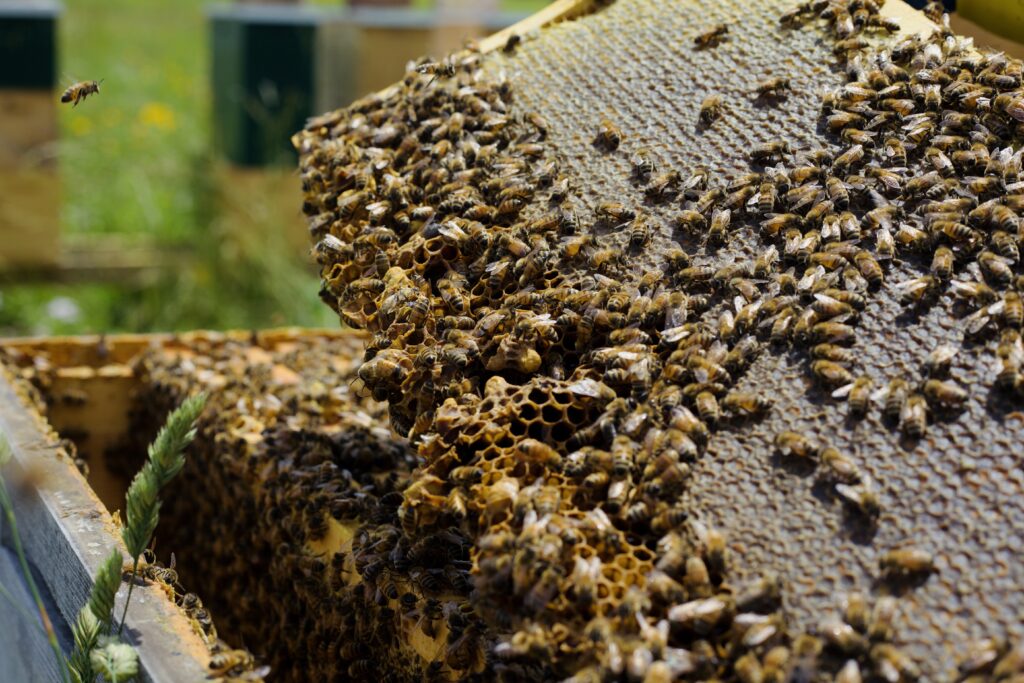
Our priority is strong, healthy and productive bees. As of 2026, the Ohio Department of Agriculture requires that ‘beekeepers who sell, trade, gift, or otherwise distribute queen bees, packaged bees, nucleus colonies (nucs), or full colonies’ obtain annual health certifications for their operations. In order to comply with this regulation, beekeepers agree to inspect for diseases and varroa infestation at least twice a year.
Just like any managed livestock, honey bees contract and spread diseases, and to minimize the hazard to other beekeepers, monitoring for problems goes a long way to prevent their spread. The most challenging diseases are (the worst) American foulbrood, European foulbrood, and now the viruses spread by varroa mites. Parasitic mites have been chronic problems, beginning with tracheal mites in the 1980’s, followed in short order by varroa mites, and hopefully never, the Tropilaelaps mite.
We are surrounded by homeowners who use chemicals on their yards, and farms, both of which means pesticide exposure, and pesticides are sequestered in beeswax. Once again in the pursuit of healthy colonies, we cycle out the older, dark comb by melting it off and starting fresh every 5 years.
We have appreciated the efforts of our local inspector through the years, finding him very helpful, and hope that the new inspection program continues to provide the resources to the counties to keep honey bees safe from harm.
Raising Bees
After our package experiences, we resolved to do beekeeping as sustainably as possible so that we would not have to buy bees from other beekeepers. Aside from bee box and mite control products, we try to produce all we need to maintain the apiary and provide enough surplus honey to sell to offset costs. We view the bees as livestock entrusted to our care, just as we did the pigs and cows we used to raise, just better-smelling.
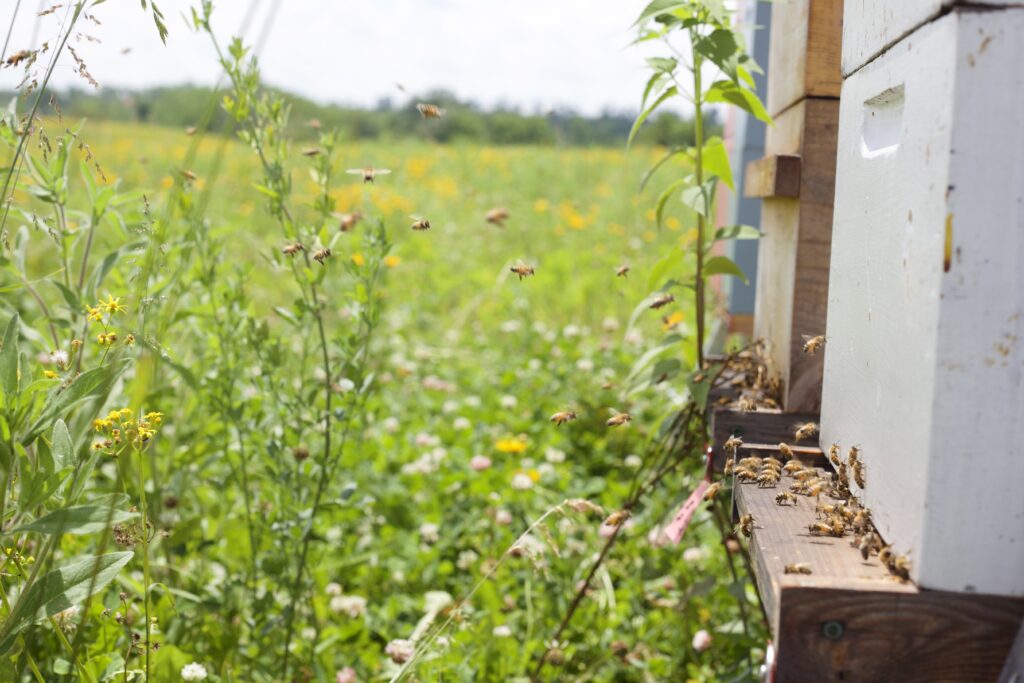
We last bought a handful of Italian queens in 2020, and in 2022 added a Saskatraz and 2 Carniolans. The Italians have culled themselves, but the Carniolan line, while much diluted, persists. We now rear all our own queens, using genetics from feral bees as the foundation for Ohio-tolerant, hardy colonies. The feral bees’ backgrounds are completely unknown, so our bees are ‘local survivor stock’.
Our queen rearing process begins in spring with trapping swarms in areas where managed colonies are not present. In this environment, swarms are the natural product of a healthy colony of some age that has overwintered well. In principle, in trapping a swarm of these ‘survivor’ bees, we are also trapping a strong laying queen, a vigorous workforce, and potentially, mite resistant genetics.
These bees, while unmanaged for years, have shown themselves to be agreeable and easy to work with, solid honey producers, and most importantly, more in sync with the Ohio’s climate. We have come to understand that adaptation to Ohio weather is not so much about cold and heat tolerance as timing brood production to resource availability.
After hiving the swarms, we assess the queen’s colony for health, first, then temperament and productivity, and later in the summer, varroa mite resistance. In the rest of the yard, we cull unproductive queens with consistently defensive bees and high mite counts. Starting in late May/early June we graft larvae from our favorite colonies to produce new queens. Queen rearing takes practice for consistent success, like any skill, but it is not difficult and a very handy thing to know how to do. There is no better way to learn more about your bees than going through a season making new queens, whatever method you use. Once mated, the young queens and their colonies are grown and cared for throughout the year to use for requeening older colonies and supplying overwintered nuc sales the following spring. So, starting with a number of swarms with all kinds of traits, we channel the yard into nice, consistent, durable colonies.
Jim’s woodshop is in the former pig nursery. Without this resource, we would still have 2 colonies. As it is, he spends a good part of the winter making boxes, bases, and lids. A few years ago, he began dipping the new boxes in paraffin wax to preserve the wood, an excellent alternative to painting.
Varroa Management
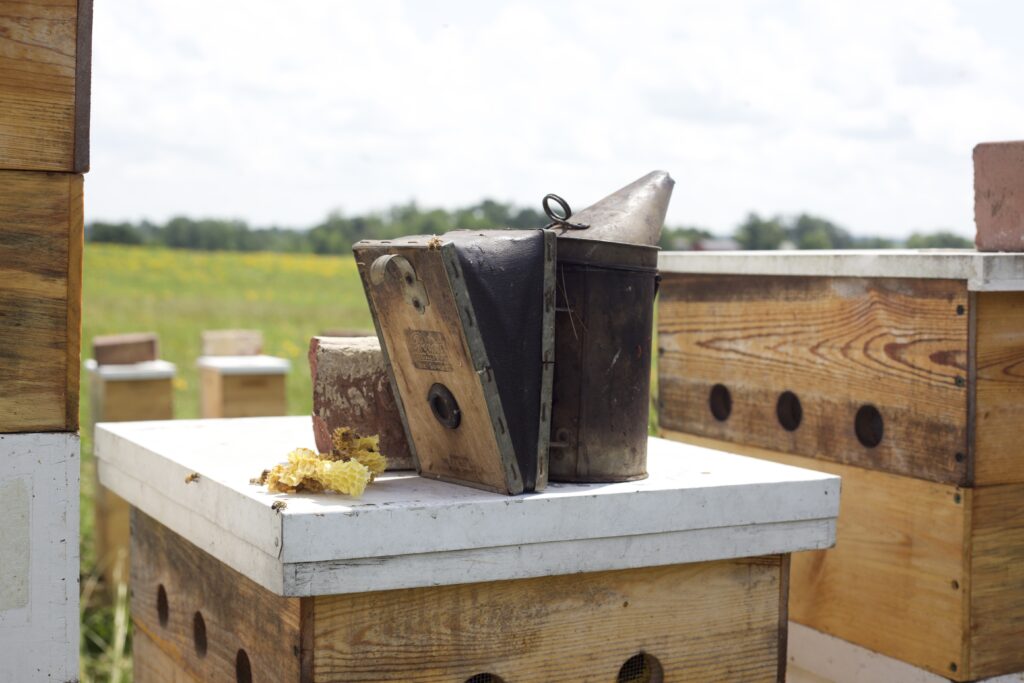
Our goals, healthy bees and sustainable beekeeping, are tied to mite management. Parasitic varroa mites weaken the bees by depleting their energy reserves, compromising their immune systems, and most importantly, acting as virus vectors. Mite control occupies too much of the work in the yards, and it is in no way fun, but it is critical until we can identify and select for mite-resistance in the colonies. After the honey crop is removed we sample each colony for mites using soapy water washes to find its level of infestation. If treatment is called for, we rely on organic acids, never synthetic chemicals, to knock them down. A winter treatment is deployed to prepare them for spring, followed by a slow-release treatment during the honey season. This is a lot of work, and expense, but the alternative is sick bees, weak hives, and preventable losses.
By identifying colonies that show a level of mite resistance we hope one day to experience what beekeeping was like before it became mite management. Breeding programs work best in isolated yards, and while we are not in any way able to implement that level of positive selection, we have seen firsthand that by selecting our queen sources with care, sampling at appropriate times and dutifully keeping records, we are able at least to eliminate highly susceptible bees.
Honey Production
We have chosen not to buy in queens with premier honey foraging traits, sticking with our own hard-working bees. The weather being what it is, the surest path to a good honey harvest is a colony overloaded with healthy field bees. This requires (what else!) timely and effective varroa management and boosting colonies with brood from resource hives in time to be ready for nectar flows. We harvest honey in late July/early August, before summer dearths. The bees find abundant high-quality nutrition in our MonarchSAFE conservation plot, the surrounding woods and swamps, and produce a flavorful wildflower honey.
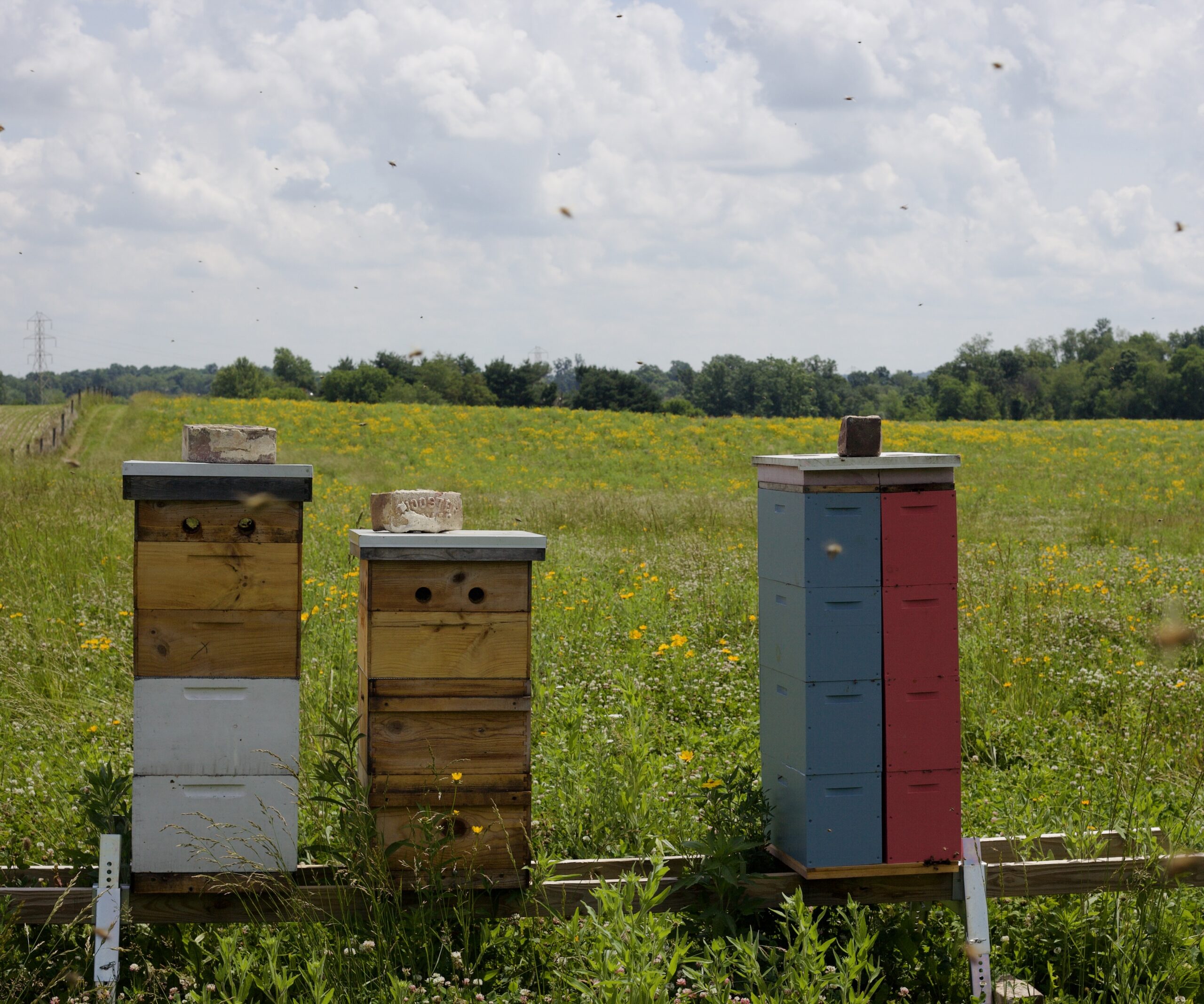
Our honey room, the barn’s old milk house, is pressure washed and the equipment scrubbed down before the boxes of honey arrive for extraction. As it is extracted the honey is coarse-filtered and stored in a cool area. It crystallizes quickly, which is an indication of its quality. Heat compromises honey’s integrity, so it is critical to store it in a temperate area and use moderate heat to dissolve the crystals when the honey is bottled. The process of uncapping the frames produces a decent volume of very clean wax, which we render to make into candles and blocks.
In the spring and fall, when the ambient temperature dips below 60, we make batches of creamed, or soft set, honey. This is nothing more than honey with a very fine crystal structure, similar in consistency to peanut butter, and much less likely to run off your toast and up your arm.
Ohio has clear and sensible packaging and labeling regulations for beekeepers who wish to trade or sell their products. For more information, start with your county Auditor’s Weights and Measures Inspector, Health Department or the Ohio State Beekeepers’ Association. Jars, lids and labels are available in bulk from bee supply companies. We use a local print shop, Murr’s, for labels. We often are asked about our jar labels: the artist is Zhiwen Xu, a graduate of the University of Virginia (2023) with a dual major in biochemistry and studio art.
You can also view all of our products here: Shop Now
All photos in this post are courtesy of Annie Yoder [email protected] of Local Roots in Wooster, OH