The point of varroa mite sampling is to help us make management decisions. We want to keep low mite count colonies in the apiary but lose the queens laying high count colonies. August is the best month for assessing whether or not your bees have the genetics to manage their mites for you, rather than needing you to do the work for them. Mite numbers have been increasing all season and now bee numbers are starting to dwindle, creating a potentially deadly situation for heavily infested colonies. Once honey boxes come off and opening up hives no longer requires superhuman effort, sampling for mite numbers, while not the most fun you’ll ever have, is a worthwhile excuse for checking your bees.
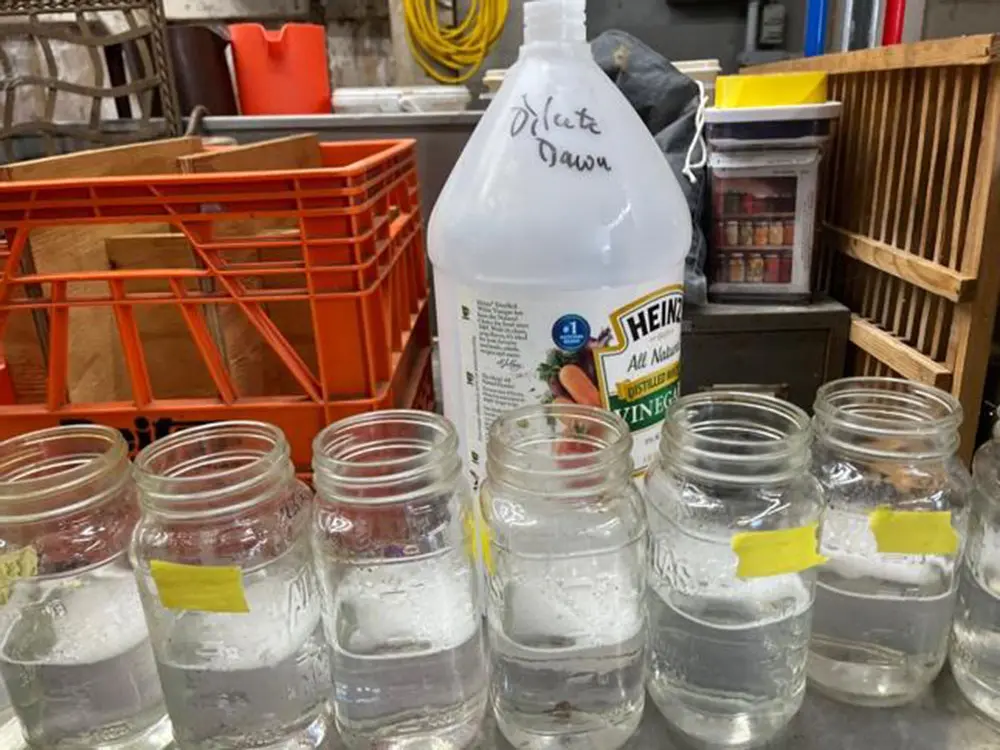
We do soapy water washes, 1 Tbsp Dawn in 1 gallon of water. We have a good supply of odd-sized canning jars, somewhere between a pint and a quart. We label the jars, fill them with 12 oz of wash, cover with a jar lid, and head out to the yards.
Sampling is an art form with each method having its pros and cons. The key to a solid answer is consistent methodology. We did a pin kill brood test in the spring to look for hygienic behavior, several mite washes through the season, and Harbo assays just recently on a select few colonies.
For a wash, if the colony is a double deep, select a frame from the lower box adjacent to emerging brood, probably the 4th or 5th at this time of year. The upper box will also contain a decent amount of brood but the mite counts will be higher in the bottom box. Take the frame away to a place where you can collect the bees without inciting a riot. In the interest of speed, we rap the frame into a plastic tub, scoop up ½ cup of bees and drop them through a canning funnel into the water. You can also carefully tease the bees off the frame, collecting them in the cup as you run it downwards. Write the colony ID on the label, restore the lid, and go on to the next colony.
While the boxes are apart, take note of the condition of the hive: its strength in frames of bees, how much brood is waiting to emerge, the condition of the uncapped brood, if the queen is doing well, etc. You can’t help but assess the weight of stores as you remove the top box! This year has been lush but many years the boxes are light and the bees have no honey stored even in the brood box, signaling the need to feed.
Back at the barn, we set up the shaking line. We swirl the jar for 30 seconds, then dump the bees into the basket of an ‘Easy Check©’ mite sampler. Swish 5 times, take out the dead bees and count the mites in the clear container. Toss the bees into the compost bucket, repeat for the next jar on down the line.
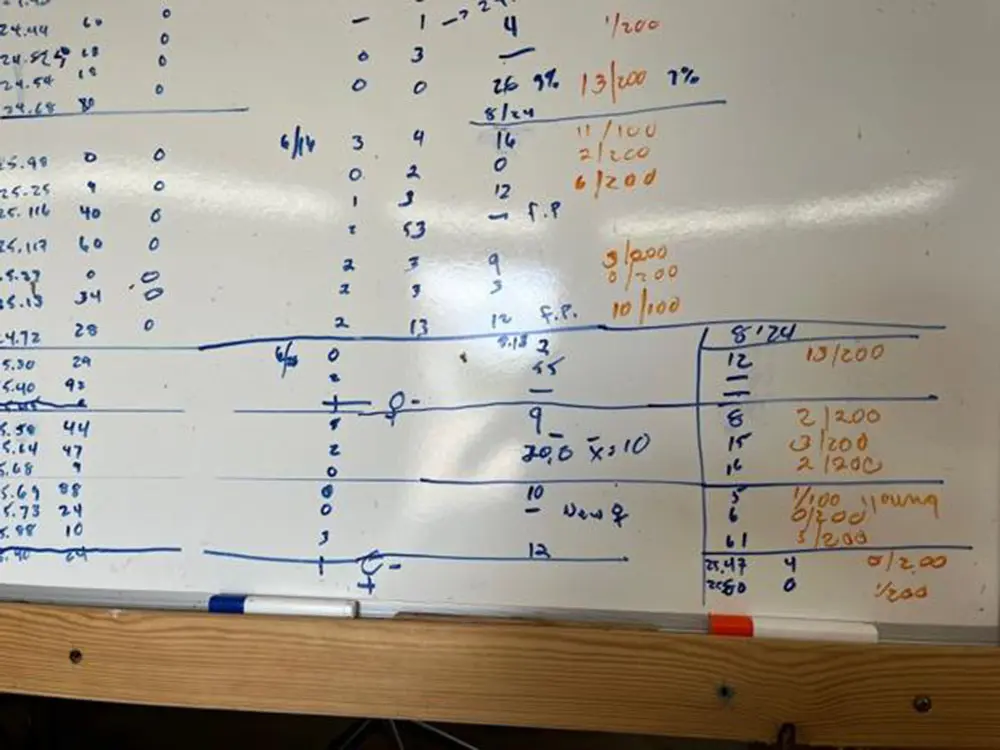
We held back a handful of colonies to keep treatment free when placing extended-release oxalic acid pads in late May/early June. On August 24th, none of the 7 untreated colonies sampled had 0 mites per the 300 bees in the ½ cup, one had 61, and the median was 12. Not an absolute count, but an estimate of the number of mites per 100 bees, our target for serious intervention at this time of year being over 5 per 100. We sampled two of the treated colonies and were pleasantly surprised to find 0 and 4 mites/300. The mite data is written in a nasty, sticky field notebook, then on a whiteboard, in a clean master notebook, and finally gets entered into a spreadsheet that includes the source of the colony’s queen, when it was started, its yard, and its death. In the photo, the first column is the hive ID, the second column is percentage of brood removed in a pin kill brood test. In the remaining columns blue numbers are mites/300 bees, and the orange ones are results of a Harbo assay. Annoyingly, there is little correlation between assays!
The information from the washes determined our fall control strategy. Knowing that Formic Pro© can be a little tough on queens and open brood, we put a full-strength treatment on the high-count colonies. The treatment will clean up the infestation, and with any luck, kill the queen for us. The remaining assets will be in high demand to boost smaller colonies going into winter. This year, the premium asset is drawn comb. Splitting and brood breaks do lower counts, but the mites and the mischief they wreak are still out there, skulking around the yards. The rest of the apiary, including the new 5-frame nucs, is being given a round of extended-release OA pads to keep the mite numbers low for winter bee health.